All In, Still Waiting: Why Record AI Investment Isn't Translating Into Returns
The headlines have been consistent for three years. AI is reshaping industries. The competitive window is narrowing. The organizations that move decisively will define the next decade.
Most executive teams have taken this seriously. Budgets approved, vendors engaged, transformation roadmaps commissioned. The ambition is genuine — and in most organizations, so is the capital behind it.
And yet, for the majority, the returns have not kept pace with the commitment.
That gap is the subject of this post. Not to catalogue the barriers — most executive teams already carry a version of that list — but to examine what's actually driving it, what the organizations breaking through are doing differently, and what the pattern implies for decisions that can only be made at the senior level.
The investment is real. The returns aren't.
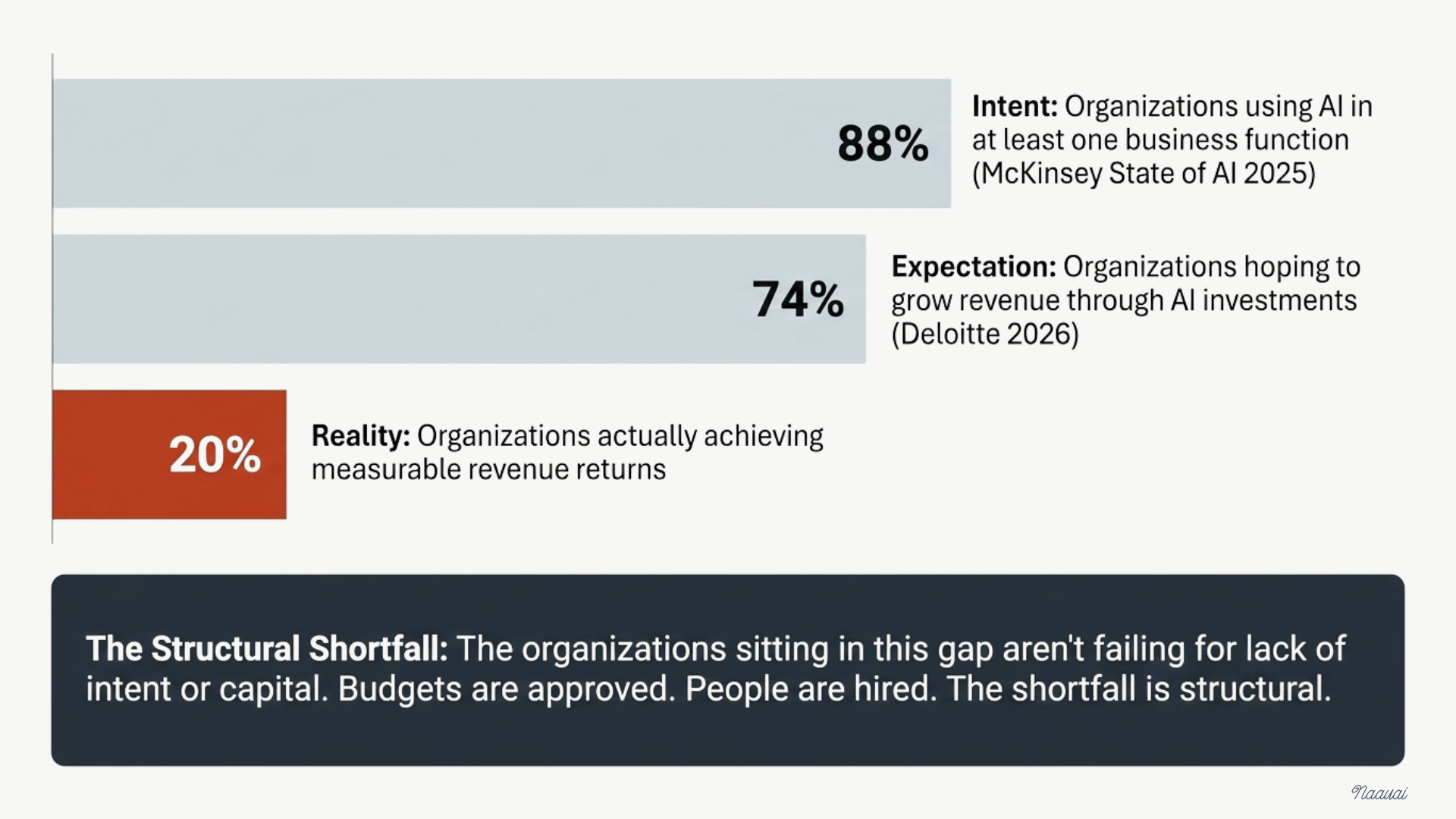
Enterprise AI adoption is now effectively universal. McKinsey's State of AI 2025, covering nearly 2,000 respondents across 105 countries, found 88% of organizations using AI in at least one business function — up sharply from the year before.
Deloitte's State of AI in the Enterprise 2026, drawing on more than 3,000 senior leaders across 24 countries, tells a harder story underneath that headline number: 74% of organizations are hoping to grow revenue through their AI investments. Only 20% are doing so.
That isn't a small shortfall — it's a structural one. And it's worth pausing on what it actually means. The organizations sitting in that gap aren't failing for lack of intent or resource. They've made the investment. They've hired the people. They've approved the roadmaps. They're still waiting.
The question worth asking isn't whether AI works. The evidence that it does — for the organizations that have figured out how to deploy it — is now clear enough to treat as settled. The more productive question is what separates the 20% generating genuine value from the 74% still hoping for it.
What the organizations pulling ahead are doing differently

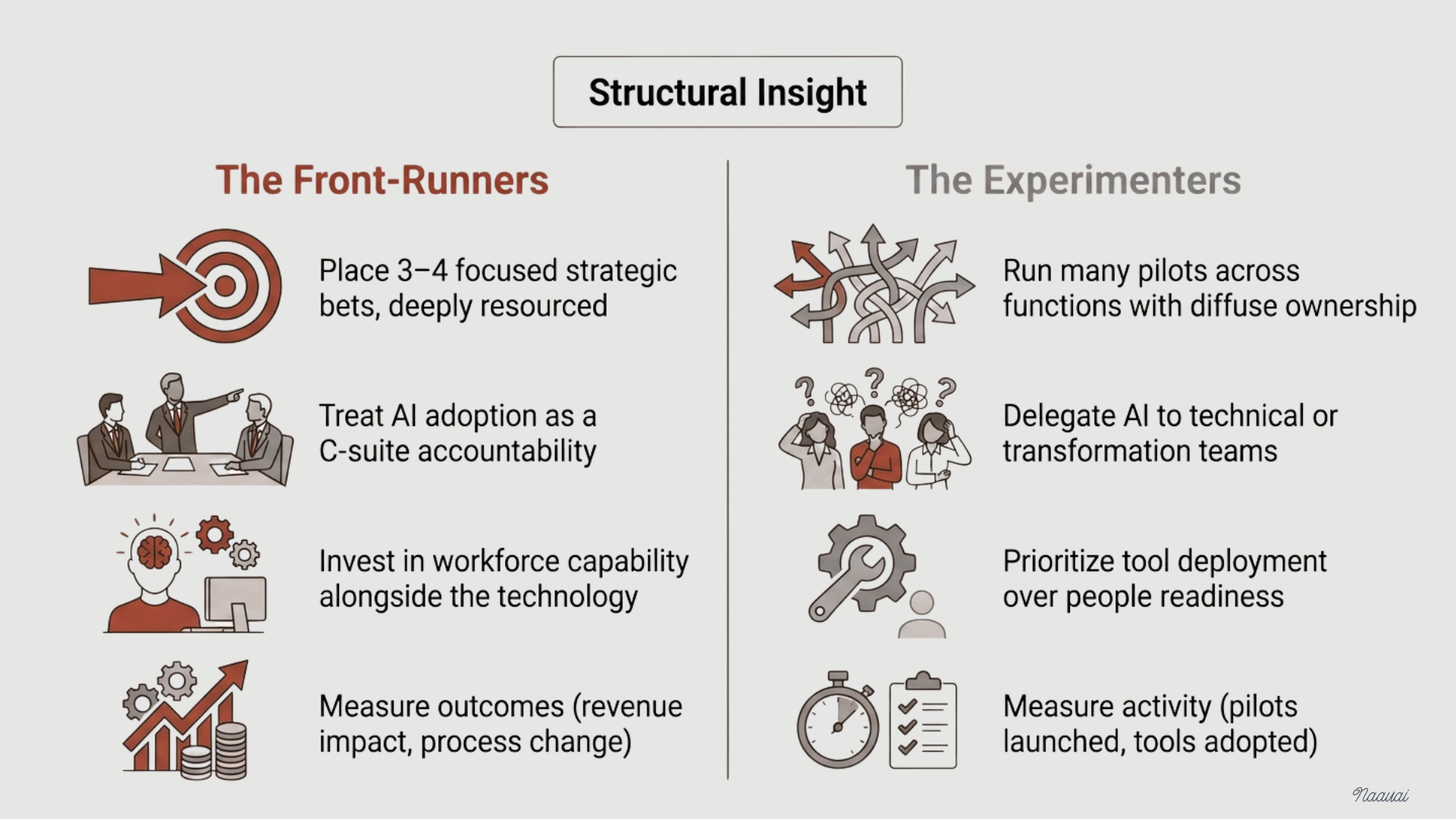
Accenture's research across 2,000 executives identifies roughly 15% of organizations as having built what it takes to scale AI successfully. Front-runners convert more than 56% of their strategic AI initiatives into scaled implementations. The experimenting majority converts around 20%.
What separates them isn't primarily the technology they've deployed. It's how they've organized around it — and who's driving.
| What front-runners do | What experimenters do |
|---|---|
| Place 3–4 focused strategic bets, deeply resourced | Run many pilots across functions with diffuse ownership |
| Treat AI adoption as a C-suite accountability | Delegate AI to technical or transformation teams |
| Invest in workforce capability alongside the technology | Prioritize tool deployment over people readiness |
| Measure outcomes — revenue impact, process change | Measure activity — pilots launched, tools adopted |
JPMorgan Chase: what sustained commitment actually produces

The most instructive example of this at scale is JPMorgan Chase — and what makes their story worth examining isn't the headline result, it's the sequencing behind it.
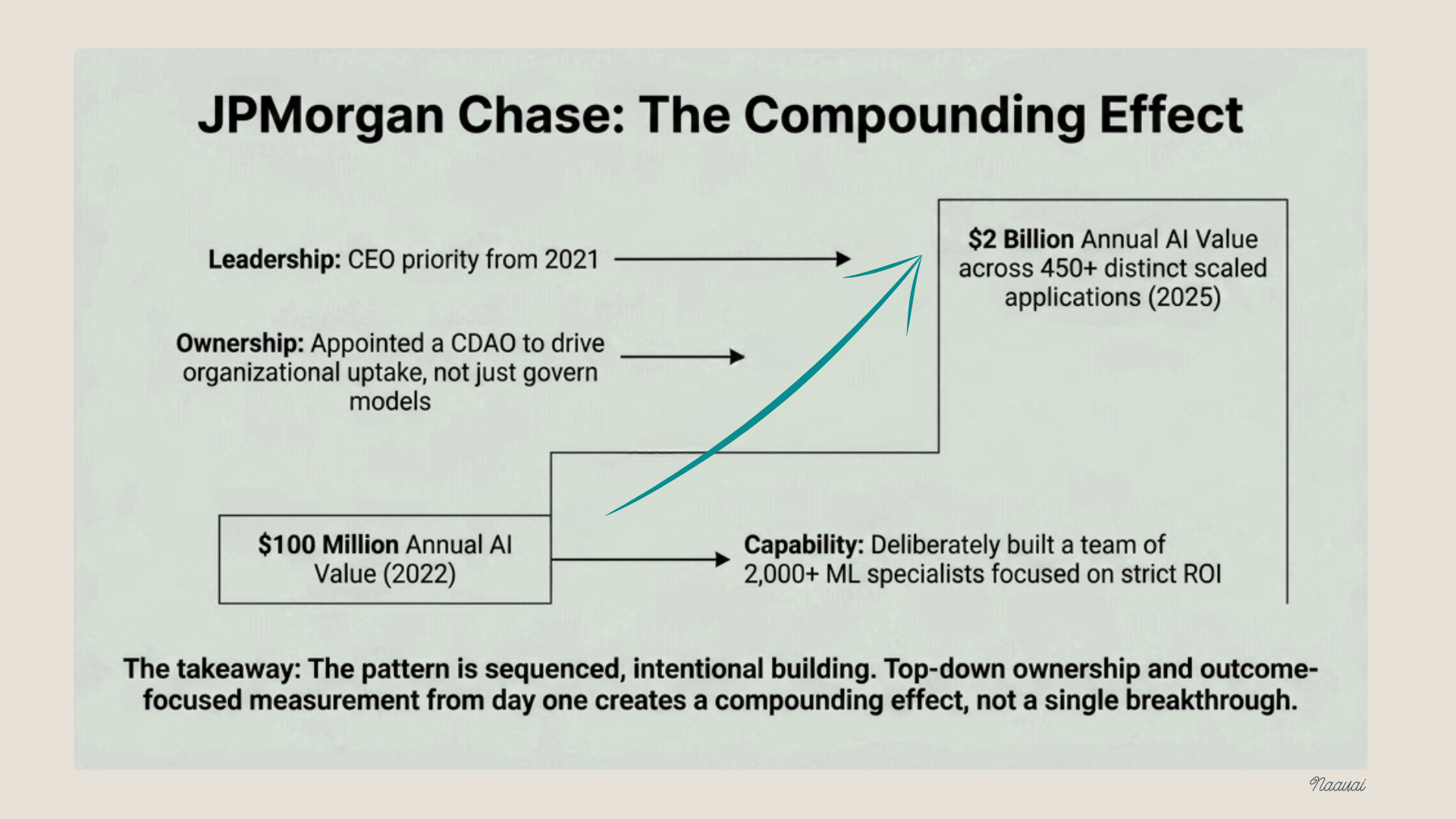
Jamie Dimon made AI a CEO-level priority in 2021, not a CTO-level one. The bank appointed a Chief Data and Analytics Officer specifically to own adoption across the enterprise — not to govern models, but to drive organizational uptake. Capability was built deliberately rather than imported wholesale: more than 2,000 machine learning specialists, focused on use cases with measurable ROI targets rather than proofs-of-concept designed to impress stakeholders.
The result wasn't a single breakthrough. It was a compounding effect — each use case building on the data infrastructure and organizational readiness established by those before it. By 2025, the bank had scaled more than 450 distinct AI applications and was generating $2 billion in annual AI value, up from $100 million in 2022.
The lesson for other organizations isn't that you need JPMorgan's budget. It's that the pattern — top-down ownership, capability built alongside deployment, outcome-focused measurement from day one — is consistently what distinguishes organizations that scale from those that cycle through pilots without crossing the threshold into enterprise value.
The blockers — and why this time is structurally different

The obstacles between ambition and scale are well-documented. Data quality, legacy system integration, change management, ROI measurement frameworks that don't fit how AI value actually accrues. Most executive teams can name them. Most are already allocating resource to address them.
But two of these deserve more interpretive attention than they typically receive in boardroom conversations — because AI changes the consequences of getting them wrong in ways that previous enterprise technology transitions didn't.
Data readiness: a familiar problem with unfamiliar stakes

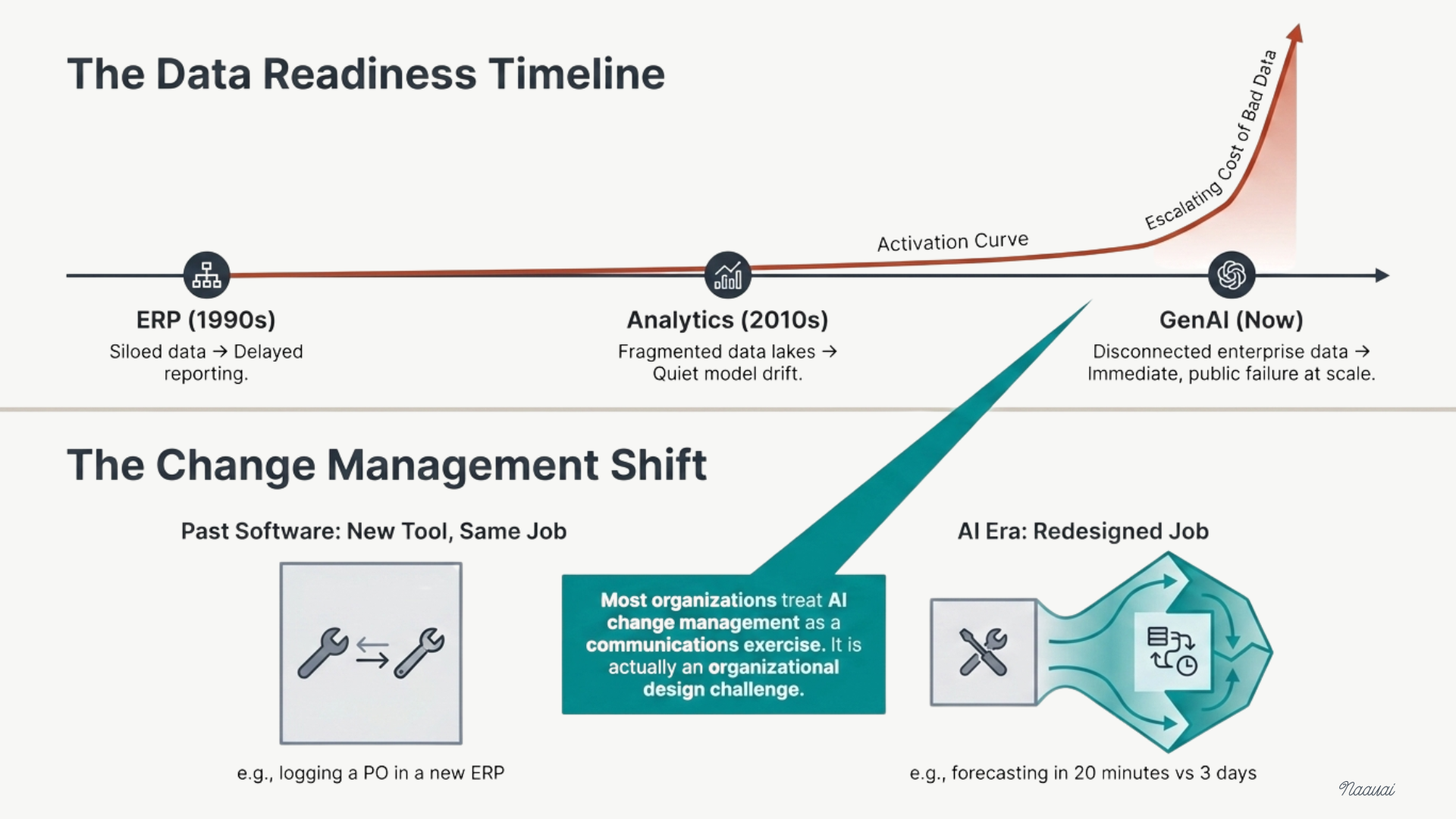
Data readiness has been the critical implementation risk in every major enterprise technology cycle of the past thirty years. What's changed in the AI era isn't the nature of the problem. It's the visibility and velocity of the consequences when organizations get it wrong.
| Era | The core data problem | What failure looked like |
|---|---|---|
| ERP (1990s–2000s) | Siloed, inconsistent data across business units | Implementations overran; reporting remained unreliable for years post-launch |
| ML / Analytics (2010s) | Fragmented data lakes, weak governance | Models trained on dirty data drifted quietly — the "data swamp" failure mode |
| Generative AI (now) | Disconnected enterprise data, ungoverned unstructured content | Models amplify the gaps — surfacing errors in customer-facing contexts, in real time, at scale |
In the ERP era, poor data quality created reporting problems that took months to surface and longer to fix. In the analytics era, bad training data produced model drift that teams took weeks to diagnose. In the AI era, a model built on poor data foundations surfaces unreliable outputs immediately — at the point of use, visible to the customer or the colleague relying on it.
The gap between good and poor data infrastructure has never been more expensive, or more public. organizations that deferred that investment through the analytics era are finding it significantly harder to scale AI now. The debt has compounded — and the interest is being paid in failed deployments.
Change management: why AI is structurally different from every previous software rollout
Every major enterprise software transition has required change management. But the nature of the change has always been the same: a new tool for recording or processing work that already exists. ERP changed how a procurement team logged a purchase order. CRM changed how a sales team tracked a customer relationship. The work itself remained recognizable; the system used to do it changed.
AI changes what work is.
A financial analyst who previously spent three days building a forecast model can now have a working baseline in twenty minutes. An operations team that previously reviewed exception reports manually can now have AI surface the three decisions that actually require human judgment. In both cases, the question that follows — what does this person do with the time AI has freed, and how do we manage, measure, and develop them in that new shape? — isn't a configuration question. It's a job design question. A capability question. A management question.
Most organizations are treating AI-era change management as a communications exercise — town halls, FAQs, a change readiness survey. The organizations making progress are treating it as what it actually is: an organizational design challenge that begins with senior leaders making explicit decisions about what work should look like on the other side of adoption.
Those decisions don't get made at the implementation layer. They get made — or they don't get made — at the top.
The upstream variable
McKinsey's State of AI 2025 identified a pattern that held consistently across every segment it examined: high-performing organizations are three times more likely to have senior leaders who actively demonstrate ownership of and commitment to their AI programs — not leaders who approved the budget and receive quarterly updates, but leaders who are visibly driving adoption.
It's worth being precise about what that distinction looks like in practice, because passive engagement can look very similar to active engagement from the outside — until you examine which decisions are actually being made, and by whom.
| Active leadership engagement | What it's often mistaken for |
|---|---|
| Asking vendors what success looks like in 12 months and holding them to it | Attending the demo and approving the next phase |
| Making the organizational calls — role redesign, incentive alignment — that unblock adoption | Delegating implementation decisions to the technical team |
| Building working knowledge of what AI can and can't do at a strategic level | Relying on briefings from the CAIO or CTO to stay informed |
| Making AI capability a shared C-suite accountability | Assuming the agenda is covered because a specialist has been appointed |
The data readiness problem gets resolved when a senior leader decides it's a strategic priority, not when a data team submits another budget request. The change management problem gets resolved when leadership makes explicit decisions about what work looks like after AI, not before the implementation begins. The ROI gap closes when executives start demanding outcome metrics rather than accepting activity reports as evidence of progress.
Each of the familiar blockers has a leadership decision upstream of it. That's what the research is consistently pointing toward.
The question worth bringing into the room

The organizations pulling ahead aren't waiting for conditions to improve, or for the technology to mature a little further, or for cultural resistance to resolve itself with time. They're building the conditions for scale — and the most consistent feature of those conditions is leadership that understands AI well enough to make the decisions that only leadership can make.
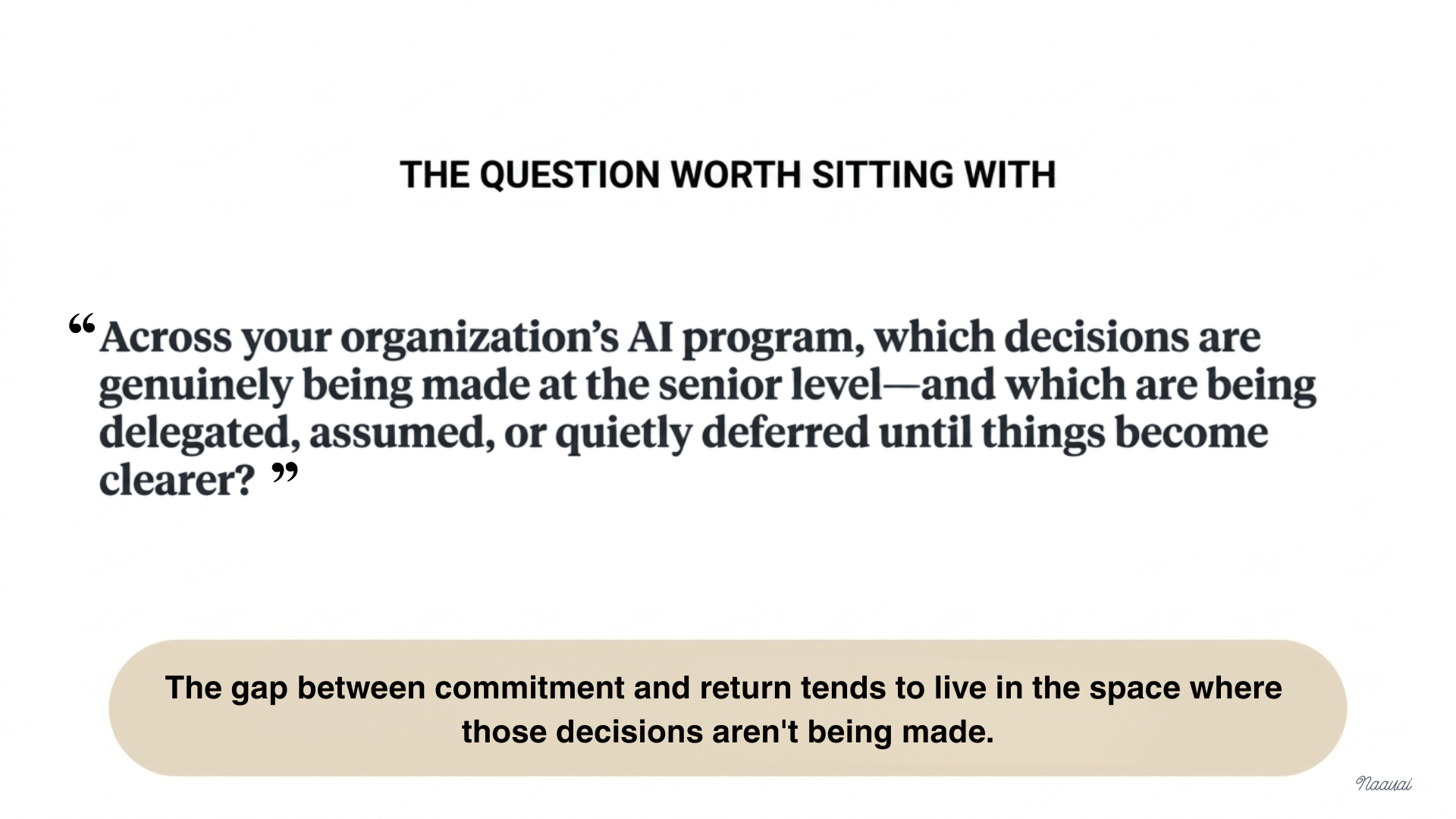
Which raises a question worth bringing honestly into the next executive conversation: across your organization's AI program, which decisions are genuinely being made at the senior level — and which are being delegated, assumed, or quietly deferred until things become clearer?
The gap between commitment and return tends to live in the space where those decisions aren't being made.
And that's a gap with a specific cause — one that the next post in this series examines directly.
Naauai's Deep Insights are designed to help leadership teams map the specific dimensions of AI maturity that matter at their level — and identify where the gap between commitment and return is most consequential for your organization. Explore the collection.
Next in the series → Still in Pilot Mode? The Data Points to a Cause Most Leaders Haven't Considered
Sources
- McKinsey & Company, The State of AI in 2025: Agents, Innovation, and Transformation (November 2025)
- Deloitte, State of AI in the Enterprise 2026 (2026)
- Accenture, The Front-Runner's Guide to Scaling AI (2025)
- John Brewton, How JP Morgan Chase Showed the Rest of Us What AI Transformations Can Achieve (January 2026)