
NaauAI
Blog

The Gap · AI Rollout

Still in Pilot Mode? The Data Points to a Cause Most Leaders Haven't Considered

Naauai EditorialNaauai Editorial
·6 min read·2026-03-02
Still in Pilot Mode? The Data Points to a Cause Most Leaders Haven't Considered

Still in Pilot Mode? The Data Points to a Cause Most Leaders Haven't Considered


You've approved the budget. You've brought in capable people. The technology demonstrated exactly what it promised. And yet, six months on, the initiative that was supposed to transform how your organisation operates is still — somehow — a pilot.

If that feels familiar, you're in the right place. And you almost certainly don't need another explainer on why AI programs stall.

So this isn't that.


You already know the usual suspects
You already know the usual suspects
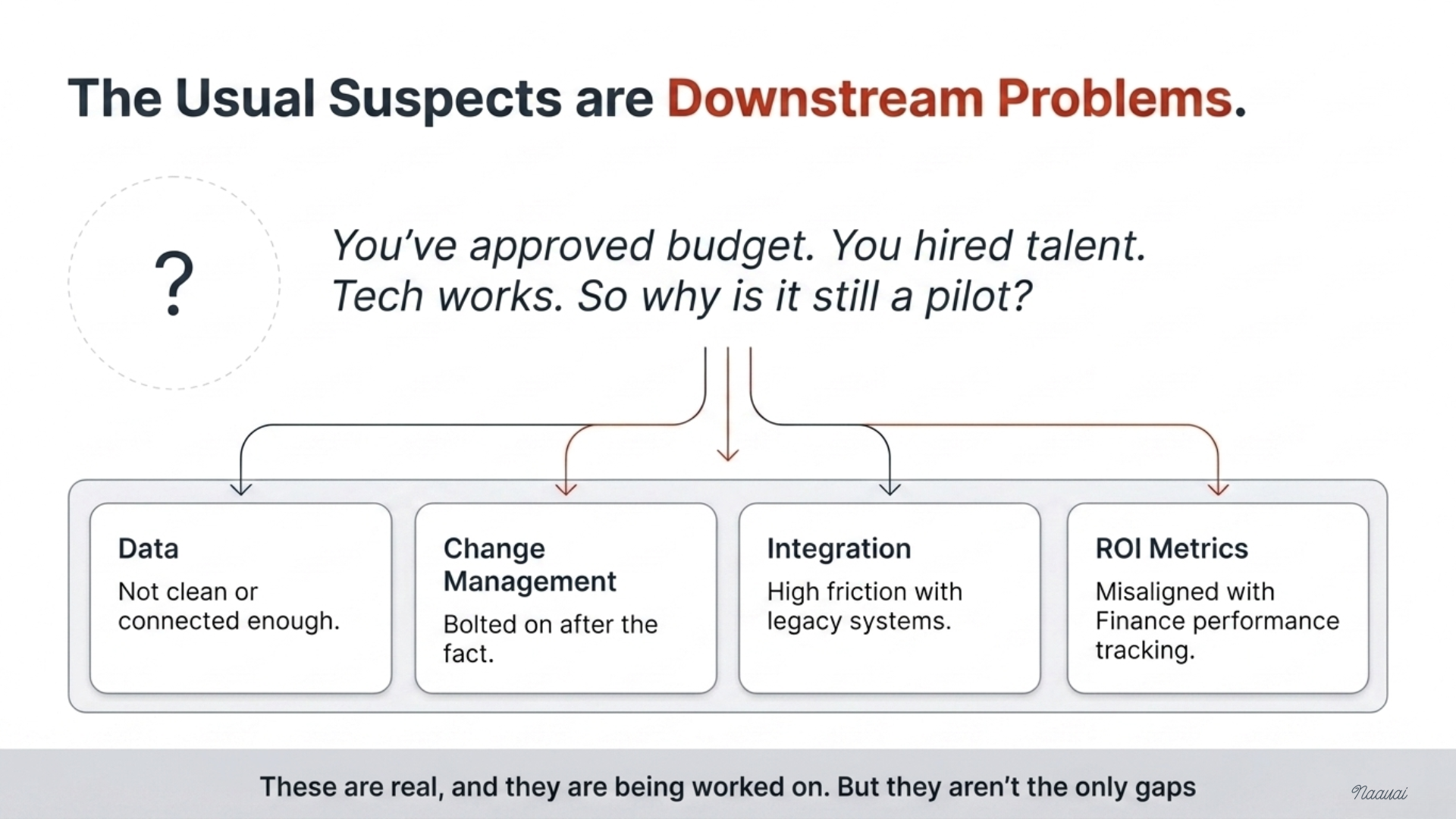
Figure 1 : The Usual Suspects

Data that isn't clean or connected enough. Change management that gets bolted on after the fact. Integration with legacy systems that turns out to be harder than the vendor suggested. ROI metrics that made sense in a presentation but don't map neatly onto how your finance team measures performance.

These are real. They're well-documented. And in most organisations navigating AI at scale, they're being worked on — with budget, with specialist resource, with genuine intent.

They're also, largely, downstream problems.

Which raises an uncomfortable question: if the known blockers are being addressed, why aren't more program scaling?

The answer emerging from the most rigorous research of the past 12 months points somewhere most organisations haven't looked — and somewhere, if we're being direct, that most leaders haven't been eager to examine.


The misdiagnosis that's costing you
The misdiagnosis that's costing you
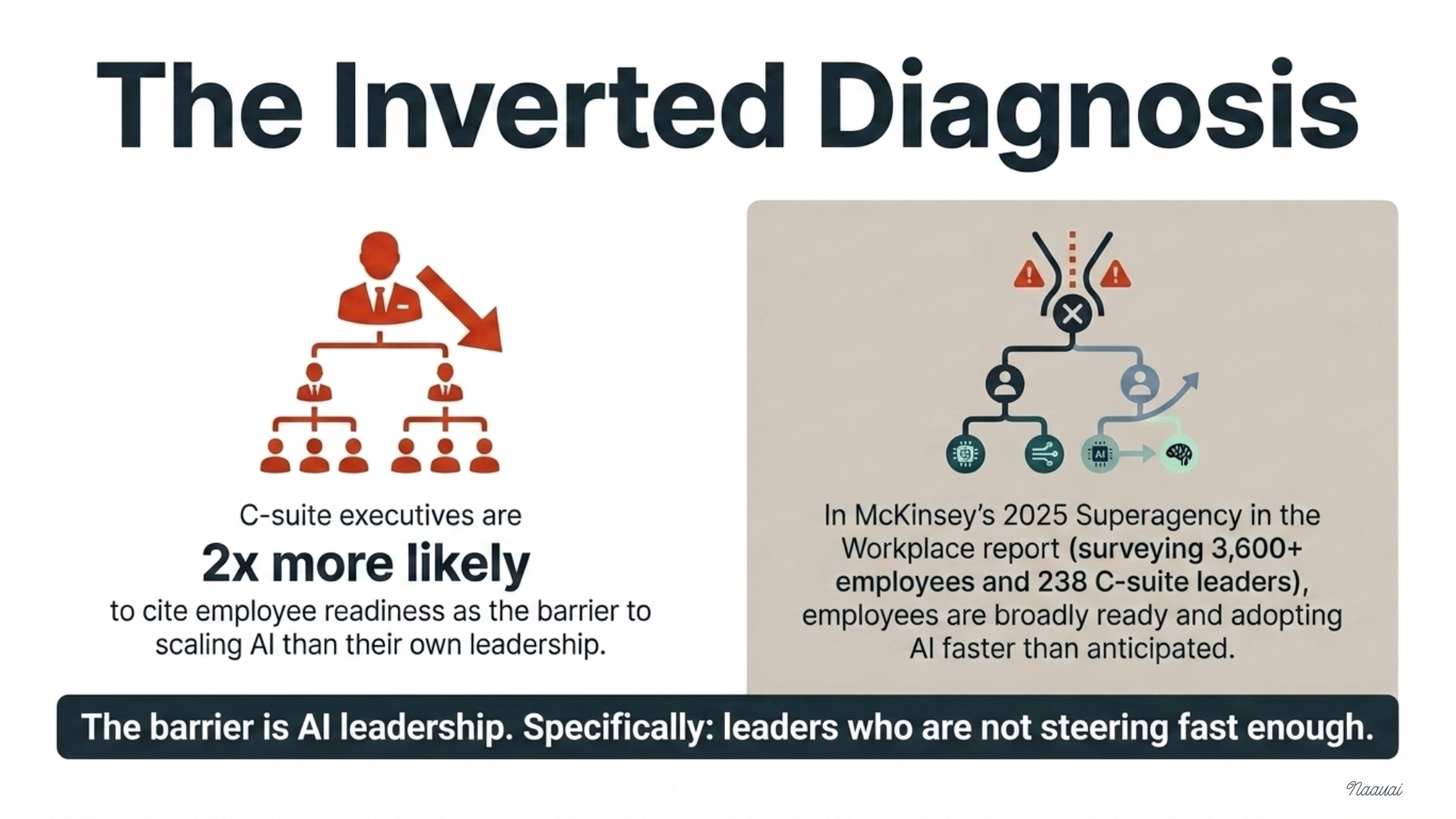
Figure 2 : Inverted Diagnosis

McKinsey's Superagency in the Workplace report, published in early 2025 and based on surveys of more than 3,600 employees and 238 C-suite leaders, contains a finding that deserves more attention than it typically receives in boardroom conversations about AI.
The biggest barrier to scaling AI, the research concluded, is not employees — who are broadly ready and, in many organisations, already adopting AI faster than their leaders anticipate. The barrier is leadership. Specifically: leaders who are not steering fast enough.

What makes this finding particularly pointed is the accompanying data on how leaders perceive the problem. C-suite executives, McKinsey found, are more than twice as likely to cite employee readiness as the barrier than to acknowledge the role of their own leadership. The diagnosis, in other words, has been inverted. The people closest to the problem are looking in the wrong direction.

This isn't a criticism — it's a structural observation. When you're operating at the level of strategic oversight, and when the technical complexity of AI can feel genuinely opaque, it's natural to attribute friction to the layers below. But the data suggests that instinct is leading most leadership teams away from the lever that actually matters.


What the numbers say about leaders who engage differently

What happens when leader steer?
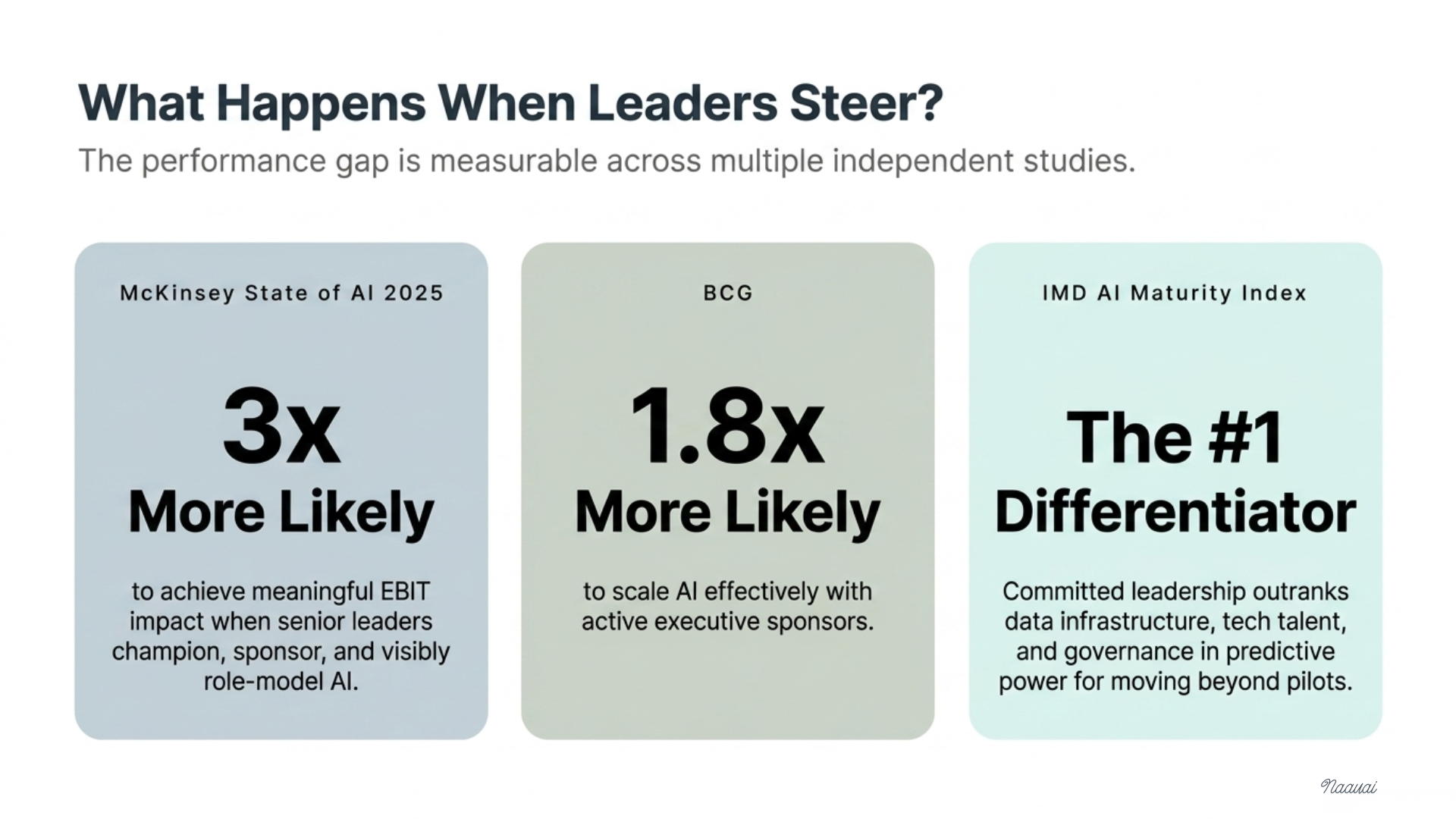
Figure 3 : Steered AI Programs

The performance gap between organisations that are scaling AI and those that aren't is now large enough to measure with precision — and the differentiating factor is consistent across multiple independent research programs.

McKinsey's State of AI 2025 survey, covering nearly 2,000 respondents across 105 countries, found that high-performing organisations — those attributing meaningful EBIT impact to AI — are three times more likely to have senior leaders who actively champion, sponsor, and visibly role-model AI use. Not leaders who approved the budget and receive quarterly updates. Leaders who are demonstrably engaged with AI as a strategic priority.

BCG's research sharpens the picture further. Organisations with active executive sponsors are 1.8 times more likely to scale AI effectively. And IMD's AI Maturity Index, drawing on research across 300 global companies, identified committed leadership as the single most consistent differentiator in organisations that have moved beyond pilots — sitting above governance frameworks, data infrastructure, and technical talent in terms of predictive power.

The pattern is consistent enough to be treated as more than correlation. Where leaders understand AI well enough to set direction, ask informed questions, and make the organisational calls that unblock progress, programs scale. Where that understanding is thin — where leaders disengage from active direction because the subject feels outside their domain — programs tend to stay exactly where they are.


This isn't about learning to code

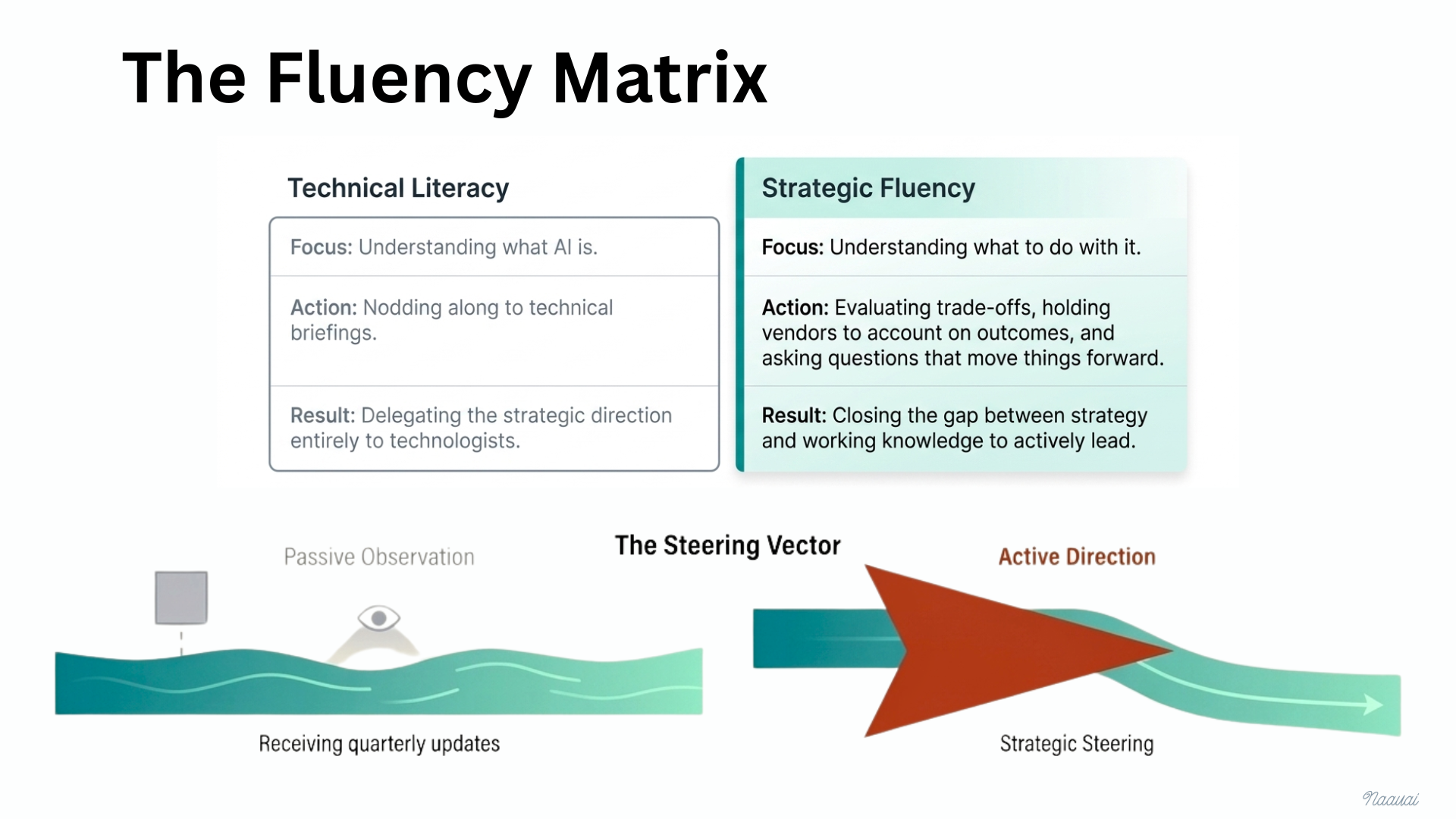
Fluency Matrix
Figure 4 : From Technical Literacy to Strategic Fluency

It's worth being precise about what "leader engagement with AI" actually means in practice, because it's easy to hear this argument and conclude that the solution is a technical upskilling program. It isn't.

The research is specifically about fluency — the ability to understand what AI can and can't do at a strategic level, to evaluate trade-offs intelligently, to hold vendors and internal teams to account on outcomes rather than outputs, and to ask the questions that move things forward. MIT Sloan's work on this distinguishes clearly between technical literacy (understanding what AI is) and strategic fluency (knowing what to do with it, and what decisions only you can make). The leaders breaking through aren't the most technically sophisticated people in the room. They're the ones who have closed the gap between their strategic role and their working understanding of AI well enough to lead it — rather than delegate it entirely.

That gap is learnable. It closes faster than most leaders expect. And closing it turns out to be the upstream variable that makes almost everything else downstream easier to resolve.


The question worth sitting with

The question worth sitting with
Figure 5 : The Question

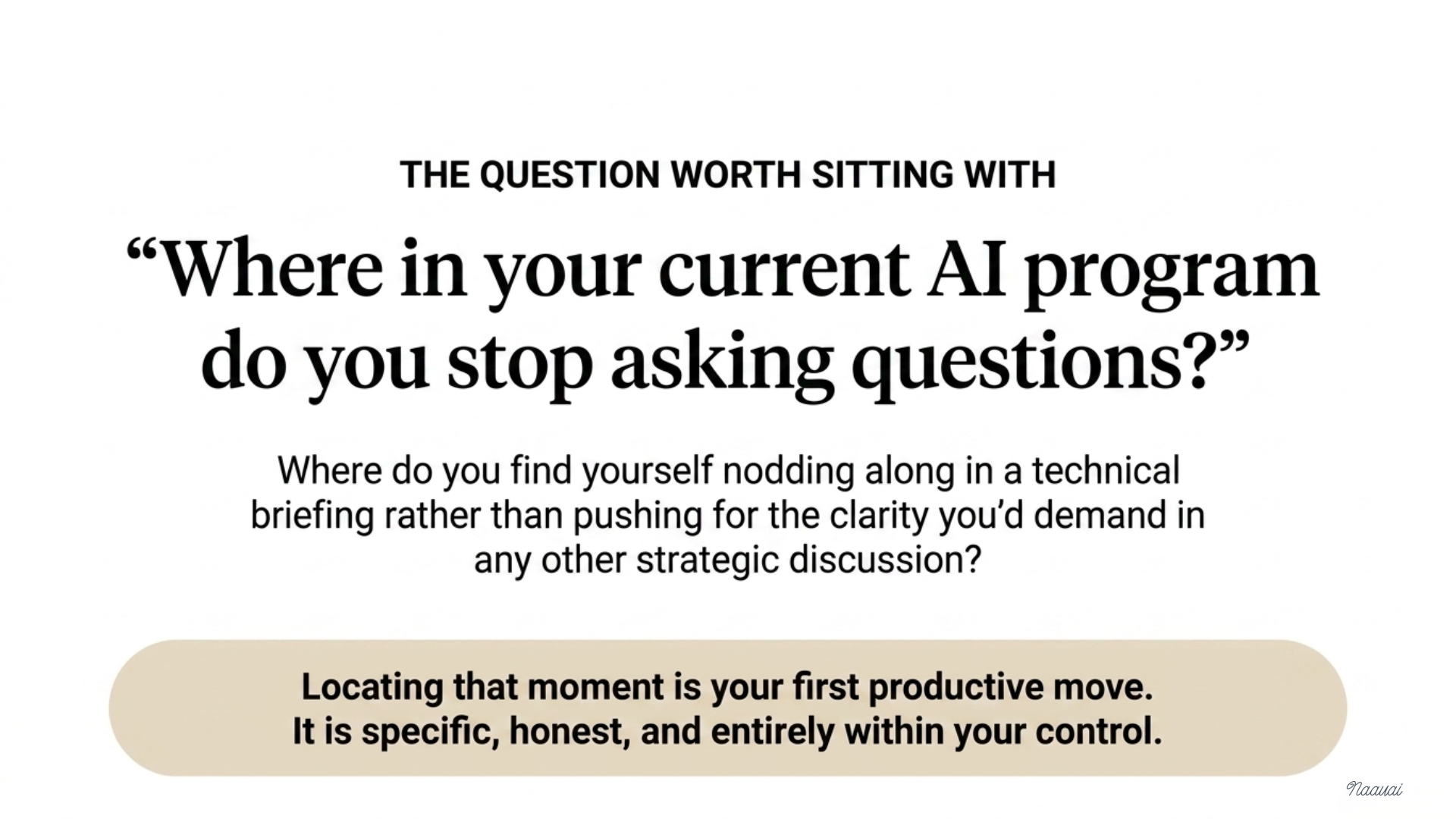
Where in your current AI program do you stop asking questions?

Not because there's nothing to ask — but because the subject starts to feel like someone else's domain. Where do you find yourself nodding along in a technical briefing rather than pushing for the clarity you'd demand in any other strategic discussion?

That moment — the point where a leader steps back from active direction — tends to be precisely where the organisation loses the steering it needs to scale.

Locating that moment is the first productive move. It's specific, it's honest, and unlike most of the downstream problems on your AI agenda, it's entirely within your control to address.


Naauai's Strategic Assessment is designed to help leadership teams locate exactly that gap — clearly, quickly, and in the context of what it means for your organisation's AI agenda. Take the journey with us.


Next in the series → The 80/20 Rule Nobody Tells You About AI


Sources

  • McKinsey & Company, Superagency in the Workplace (January 2025)
  • McKinsey & Company, The State of AI in 2025: Agents, Innovation, and Transformation (November 2025)
  • Boston Consulting Group, AI Adoption in 2024: Where's the Value? (2024)
  • IMD Business School, AI Maturity Index 2025
  • MIT Sloan Management Review, Bridging AI Literacy and Strategic Fluency (2025)
← All articlesRequest Access
NaauAI

Executive AI intelligence for leaders who take the next decade seriously. Curated by practitioners, designed for decision-makers.

SOC 2 Compliant
Enterprise Ready

Platform

  • Content Library
  • AI Executive Advisor
  • Learning Paths
  • Notebooks
  • Research Hub

Company

  • About Naauai
  • Editorial Standards
  • Our Advisors
  • Enterprise
  • Contact

Resources

  • Intelligence Feed
  • Frameworks
  • Case Studies
  • AI Fluency Assessment
  • Pricing
© 2026 NaauAI. All rights reserved.
Privacy PolicyTerms of ServiceCookie Policy