The 80/20 Rule Nobody Tells You About AI
You bought the technology. It works. The demos were impressive, the vendor delivered, and the proof-of-concept did exactly what it said it would. So why does the transformation feel like it's still somewhere on the horizon?
This is the question sitting quietly behind most AI investment reviews right now. Not "did we pick the right tool?" — the tool is fine. But something about the gap between what the technology can do and what the organization is actually getting from it isn't closing the way anyone expected.
There's a reason for that. And it's one that almost never appears in the vendor pitch.
You bought the 20%
Most organizations have approached AI investment the way they've approached every major enterprise technology investment for the past thirty years: identify the capability, source the vendor, manage the implementation, monitor adoption. It's a proven model. It's what professional, disciplined organizations do.
The problem is that AI doesn't behave like previous enterprise technology. It doesn't slot into existing processes and make them faster. It changes what those processes can be — and that change doesn't happen automatically just because the software is running.
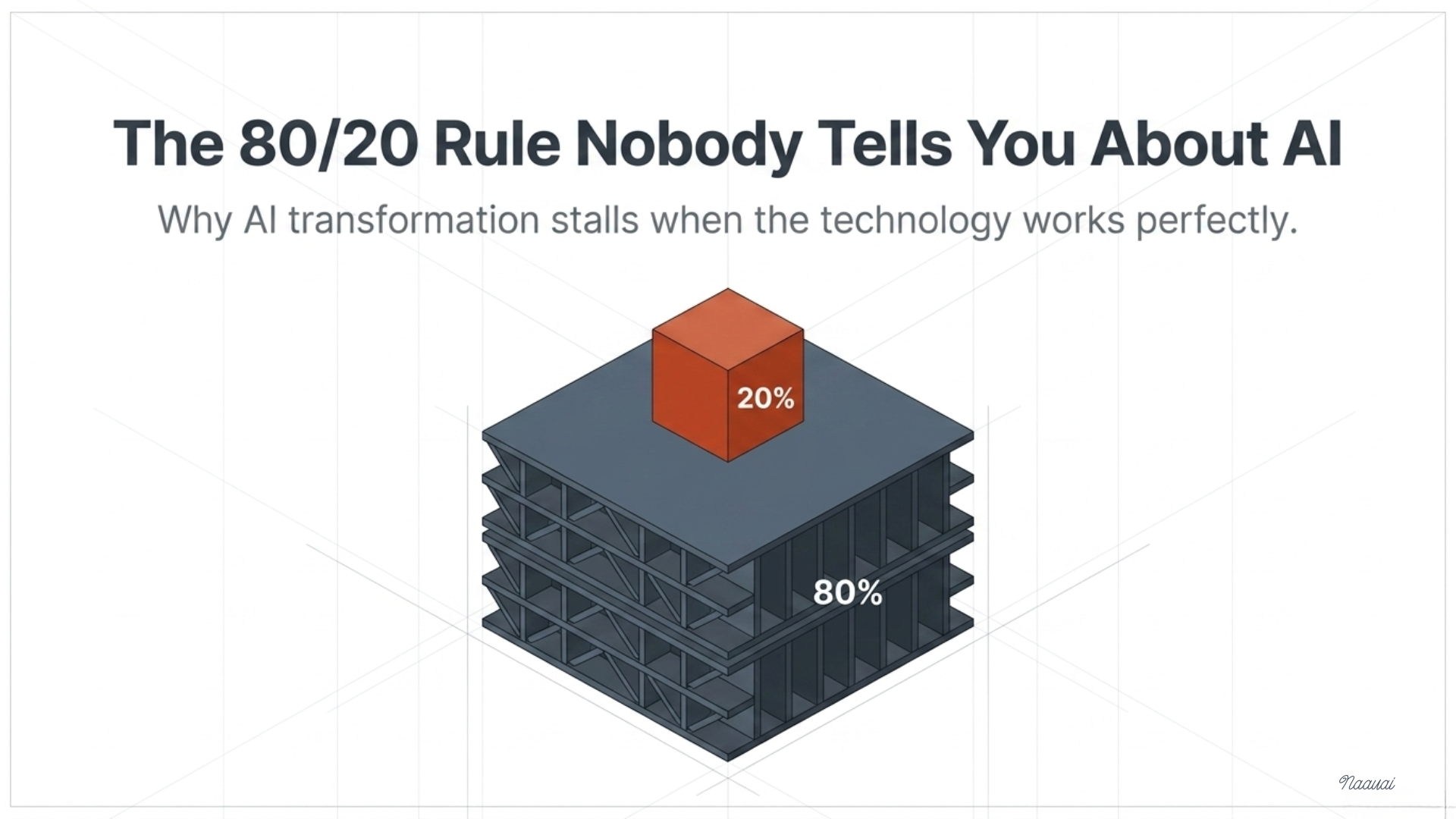
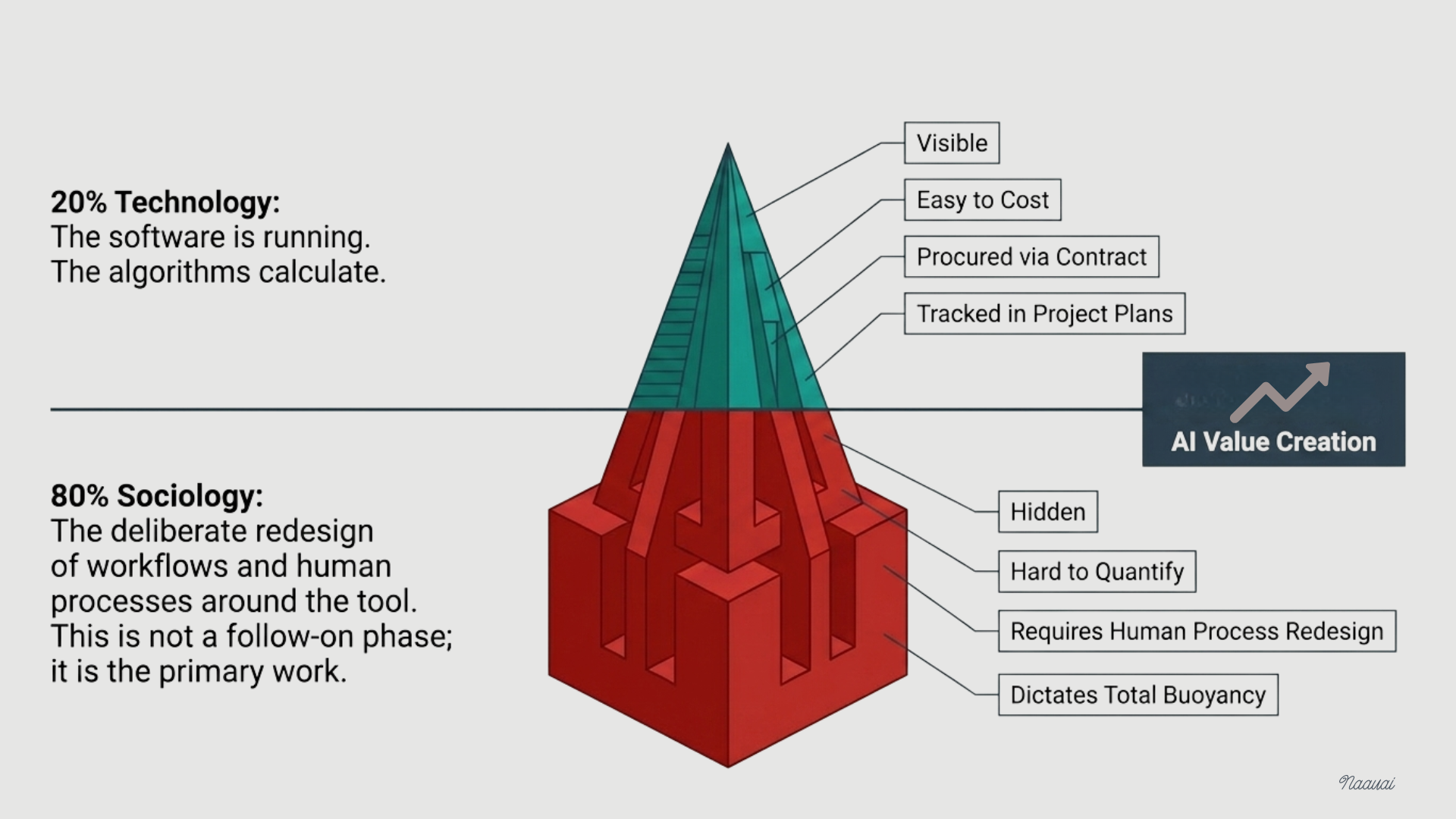
PwC's research on AI value creation is direct on this point: technology accounts for roughly 20% of the value AI can generate. The other 80% comes from the deliberate redesign of workflows and human processes around it. Not as a follow-on phase once adoption picks up, but as the primary work — the thing that determines whether the 20% ever pays off.
That ratio has a habit of not making it into the investment case. The 20% is the part you can cost, procure, and track in a project plan. The 80% is harder to quantify, harder to assign, and — it turns out — significantly harder to lead.
The part that doesn't come in the contract
There's a useful way to think about what the 80% actually involves.
When a logistics company deploys AI to optimize its delivery network, the technology does the routing calculations. But someone still has to decide what the drivers do differently as a result. Someone has to decide how dispatchers' roles change when the AI is handling decisions they used to make. Someone has to decide how performance is now measured, how exceptions are handled, and what happens to the institutional knowledge those dispatchers carried. None of that is in the model. All of it determines whether the model creates value or just creates noise.
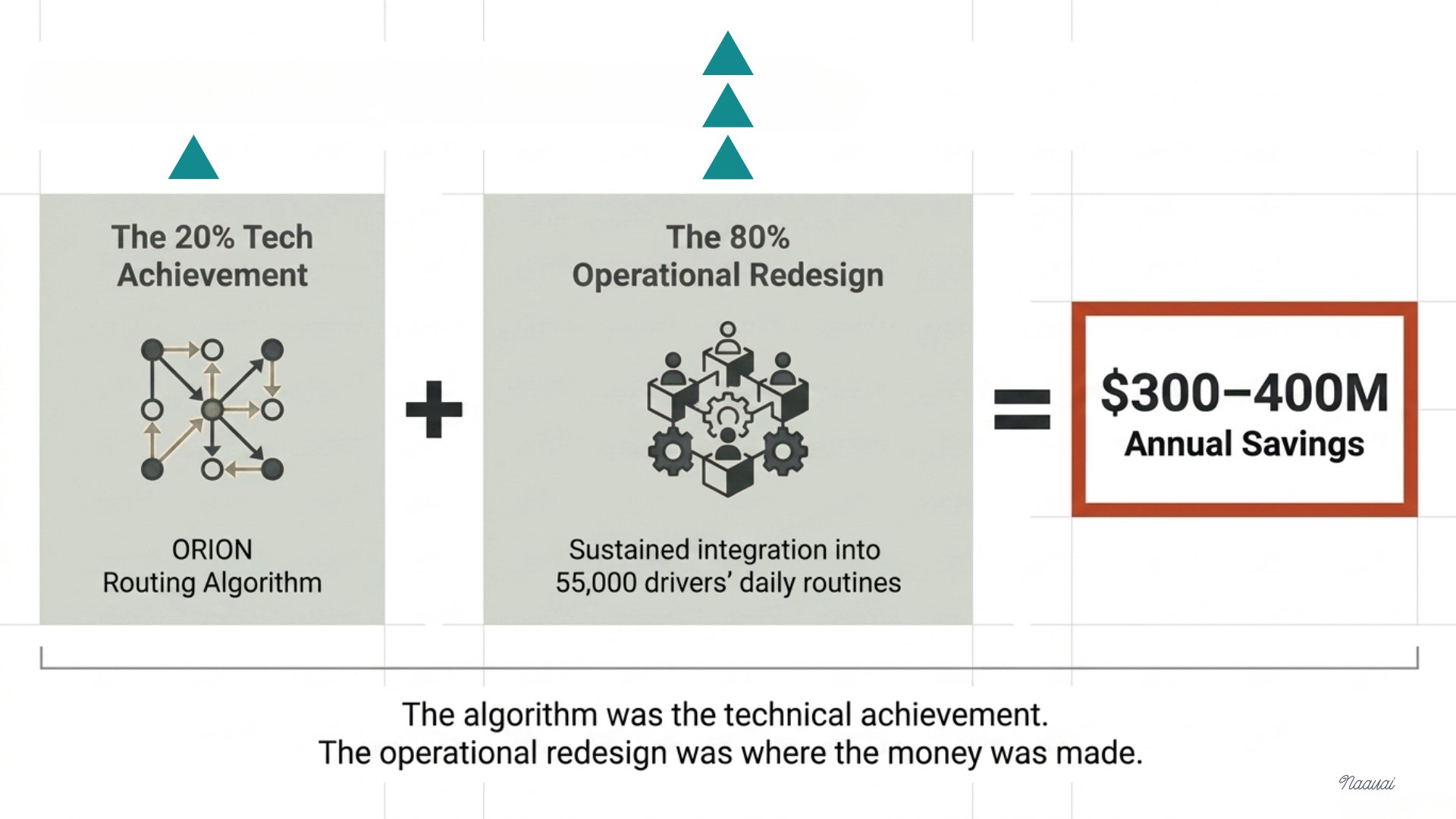
UPS's ORION system is the clearest illustration of this at scale. The AI routing algorithm was the technical achievement — genuinely impressive, years in development. But the $300–400 million in annual savings it generated didn't come from the algorithm alone. It came from the sustained organizational work of integrating it into how 55,000 drivers and their managers actually operated, day to day. The technology was the 20%. The operational redesign was the 80%.
What that redesign requires isn't a change management program or a communications rollout. It requires decisions — explicit, senior-level decisions — about what work should look like on the other side of AI adoption. Which tasks move to the machine. Which tasks evolve. Which roles change shape entirely, and how. Those decisions don't emerge from implementation teams. They have to be made at the level where organizational structure and strategic direction are set.
What the research says about who's making those decisions
The organizations generating genuine returns from AI — what Accenture's research calls "front-runners," the roughly 8% that have moved meaningfully beyond pilots — share a consistent pattern that distinguishes them from the 92% still experimenting.
They treat AI adoption as an organizational design challenge from the start, not a technology deployment that organizational adaptation will follow. They make explicit decisions about workflow redesign before scaling, not after stalling. And critically, those decisions are made at the C-suite level — not delegated to implementation teams and revisited when the ROI report comes back thin.
| How front-runners approach the 80% | How most organizations approach it |
|---|---|
| Workflow redesign is scoped before deployment begins | Workflow change is assumed to follow from tool adoption |
| Senior leaders make explicit decisions about what work looks like after AI | Implementation teams manage change as a configuration exercise |
| Role evolution is planned alongside the technology rollout | Role changes are addressed reactively when friction surfaces |
| Success is measured by how work has changed, not how many tools are live | Success is measured by adoption rates and pilot completion |
The research framing that captures this most precisely comes from work on what effective AI leadership actually requires: AI adoption is 20% technology and 80% sociology. Not in the sense that the human dimension is soft or secondary — but in the sense that it's the dominant variable in whether the technology creates value or simply creates a more sophisticated version of the status quo.
This isn't a restructuring exercise

It's worth being precise here, because "organizational redesign" can sound like a multi-year transformation program with a large consulting engagement attached to it. That's not the right frame — and it's likely the frame that causes many executives to mentally hand this off to someone else's agenda.
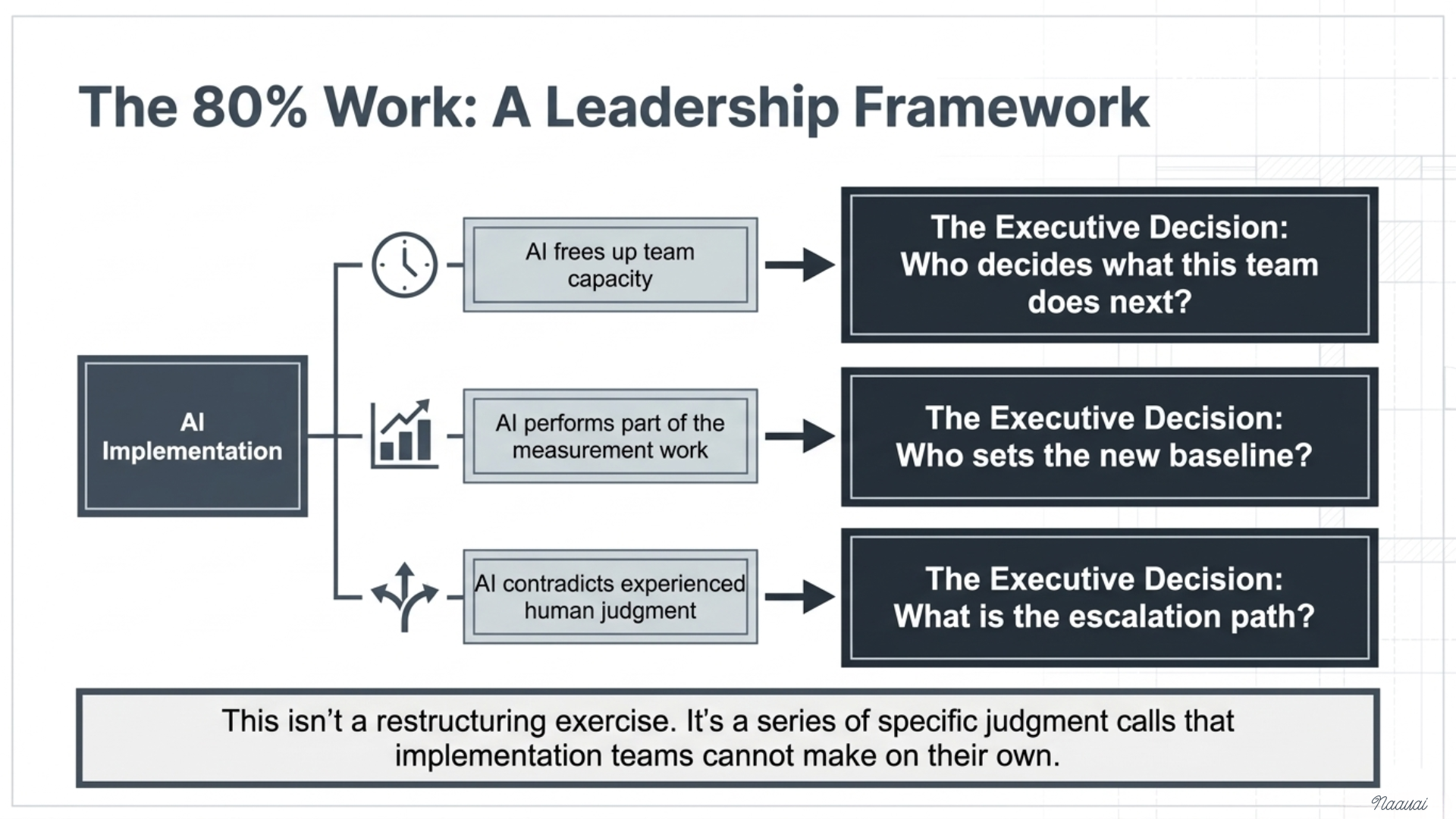
The 80% doesn't require a restructure. It requires a series of specific decisions that are, frankly, only available to senior leaders. Not because the decisions are technically complex, but because they cut across the organizational boundaries that implementation teams can't cross on their own.
What does this team do with the time the AI has freed — and who decides that? Which metrics change when AI is doing part of the measurement work, and who sets the new baseline? When AI surfaces a recommendation that contradicts experienced judgment, what's the escalation path — and who designed it? These aren't configuration questions. They're judgment calls about how the organization works, who has authority, and what performance means. They belong at the level where those things are set.
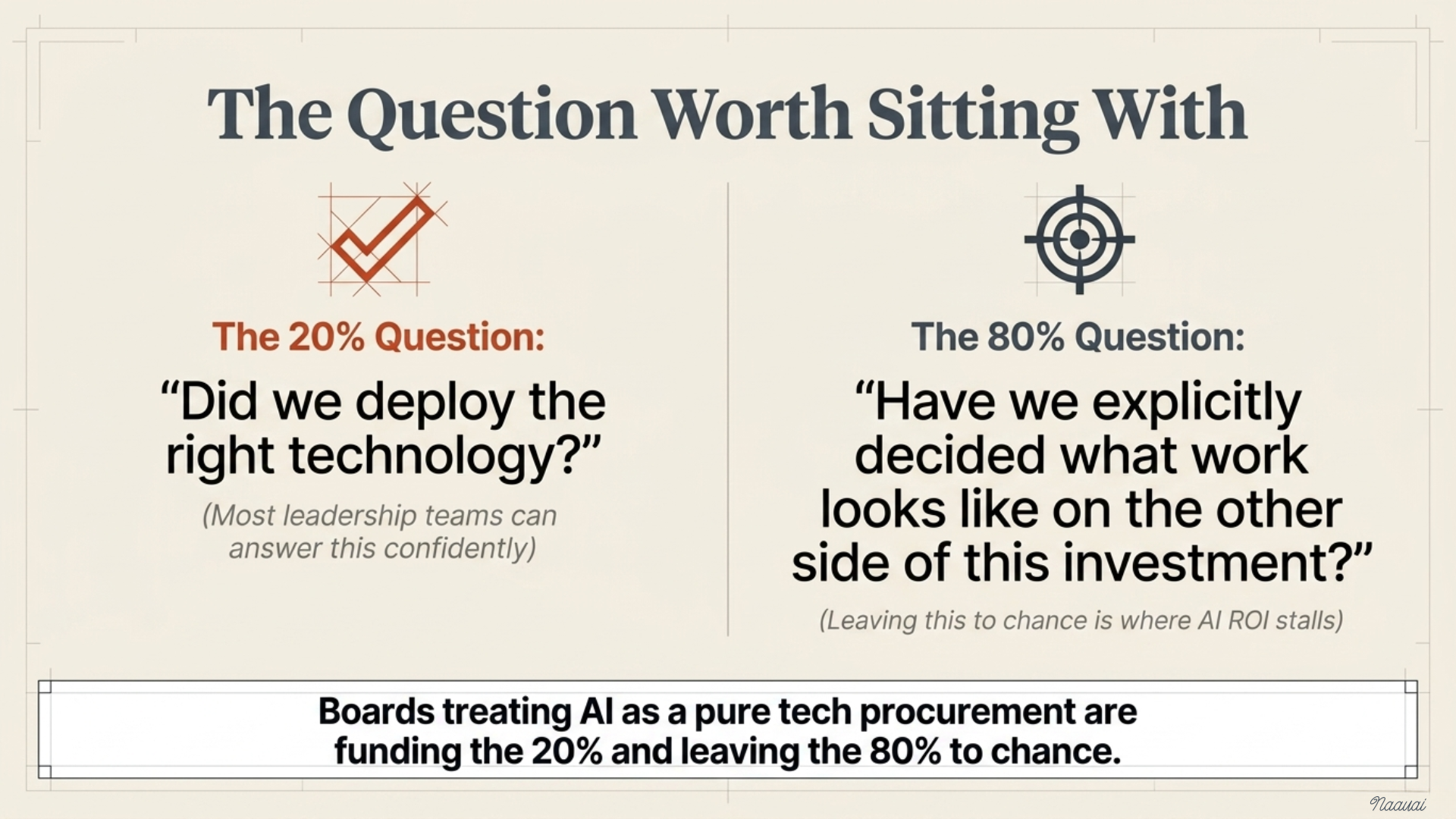
The gap PwC's research is pointing to isn't a gap in technology capability or even in workforce readiness. It's a gap in senior decision-making about the organizational shape that AI value actually requires. Boards that continue to treat AI investment as a technology procurement decision — approved, delegated, monitored — are funding the 20% and leaving the 80% to chance.
The question worth sitting with

The 20% question — "have we deployed the right technology?" — gets asked in every investment review. Most leadership teams can answer it with some confidence.
The 80% question is harder to sit with: have we actually decided what work should look like on the other side of this investment? Not delegated it to the transformation team to figure out. Not assumed it will emerge from adoption. Made it — as an explicit, senior-level organizational call.
If the honest answer is that those decisions are still sitting somewhere between the implementation layer and the executive agenda, that's worth naming. Because that's almost always where the gap between AI investment and AI return actually lives.
Naauai's Deep Insights are designed to help leadership teams engage with exactly this dimension — the organizational and strategic decisions that determine whether AI investment compounds into value. Explore the collection.
Next in the series → The Culture Problem Nobody Is Budgeting For
Sources
- PwC, AI Business Predictions 2026 (2025)
- Accenture, The Front-Runner's Guide to Scaling Enterprise AI (2025)
- PwC, 2025 CEO Study: Five Mindshifts to Supercharge Business Growth (2025)
- Empowering Visionaries, A Strategic Guide to AI Fluency for Executives (2025)
- IMD Business School, The Systems Architect: Leading AI Through Holistic Connectivity (2025)